Les voyageurs doivent avoir au moins un niveau modéré de forme physique
•
Confirmation reçue sous 48 heures, sous réserve de disponibilité
Politique d'annulation
Pour un remboursement complet, annulez au moins 24 heures avant l'heure de départ prévue.
•
Pour un remboursement complet, vous devez annuler au moins 24 heures avant l'heure de début de l'expérience.
•
Les délais limites sont basés sur l'heure locale de l'expérience.
•
Si vous annulez moins de 24 heures avant l'heure de début de l'expérience, le montant que vous avez payé ne sera pas remboursé.
•
Cette expérience nécessite un nombre minimum de voyageurs. Si elle est annulée parce que le minimum n'est pas atteint, on vous proposera une autre date/expérience ou un remboursement intégral.
•
Toute modification effectuée moins de 24 heures avant l'heure de début de l'expérience ne sera pas acceptée.
Devenez notre curateur local
Êtes-vous prêt à transformer vos passe-temps en activité lucrative ?
Découvrez les points forts de Datong lors d'une excursion de deux jours comprenant la visite des grottes de Yungang et du temple suspendu, classés au patrimoine mondial de l'UNESCO. Vous explorerez également le musée de Datong, le paravent aux neuf dragons, la pagode en bois de Yingxian et un village troglodyte. L'excursion comprend un guide et un chauffeur privés, les déjeuners et la prise en charge et le retour à l'hôtel à Datong.
Points forts
2 jours
Proposé en Mandarin & Anglais
Annulation gratuite
Billet mobile
2 jours
Proposé en Mandarin & Anglais
Annulation gratuite
Billet mobile
Ce qui est inclus
Prise en charge et retour à l'hôtel
Véhicule climatisé et propre avec chauffeur privé
Déjeuner chinois
Frais d'essence, de péage et de stationnement
Service de guide touristique anglophone
Frais d'entrée
Hébergement
Dîner
Pourboire au guide et au chauffeur
Visite privée de 2 jours à Datong
(4) Avis
Datong
À propos
Découvrez les points forts de Datong lors d'une excursion de deux jours comprenant la visite des grottes de Yungang et du temple suspendu, classés au patrimoine mondial de l'UNESCO. Vous explorerez également le musée de Datong, le paravent aux neuf dragons, la pagode en bois de Yingxian et un village troglodyte. L'excursion comprend un guide et un chauffeur privés, les déjeuners et la prise en charge et le retour à l'hôtel à Datong.
Points forts
2 jours
Proposé en Mandarin & Anglais
Annulation gratuite
Billet mobile
2 jours
Proposé en Mandarin & Anglais
Annulation gratuite
Billet mobile
Ce qui est inclus
Prise en charge et retour à l'hôtel
Véhicule climatisé et propre avec chauffeur privé
Déjeuner chinois
Frais d'essence, de péage et de stationnement
Service de guide touristique anglophone
Frais d'entrée
Hébergement
Dîner
Pourboire au guide et au chauffeur
Itinéraire
Day 1
Day 2
Datong two days tour
5 Stops
1
Yungang Grottoes
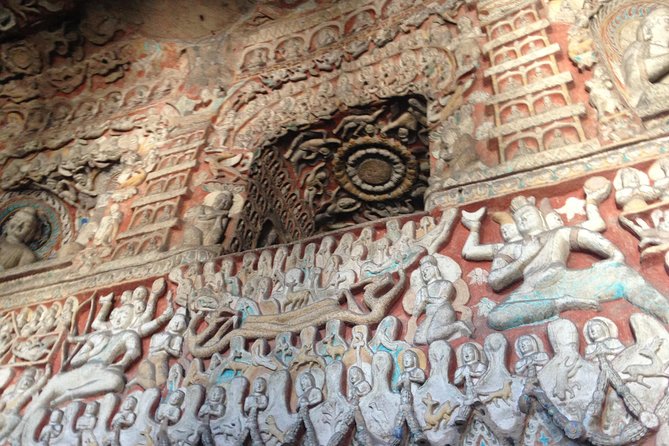
Located at the southern foot of Wuzhou Mountain, 16 kilometers west of Datong City, Yungang Grottoes were carved into the mountain and extend about one kilometer from east to west. The 45 caves in Yungang Grottoes include some 254 niches with about 51,000 statues. Yugang Grottoes constitute a classical masterpiece of the first peak of Chinese Buddhist art. In March 1961, Yungang Grottoes was proclaimed as one of the first batch of Key Cultural Relics under the protection of Chinese State Council. In December 2001, Yungang Grottoes was included as a World Heritage Site by UNESCO. In May 2007, Yungang Grottoes was proclaimed as a National AAAAA-grade Tourism Attraction of China. The expansion project in 2010 made Yungang Grottoes a world famous tourist sightseeing destination with its combination of a royal ancient Buddhist cave temple, royal garden and the complex of ancient architecture. Yungang Grottoes, with their complexity, their rich variety and vigorous features constitute a classical masterpiece as one of the three most famous Buddhist cave temples in China. The Yungang cave art represents the successful fusion of Buddhist religions symbolic art from the Buddhist Art of Gandhara (a style of Buddhist visual art that developed in what is now northwestern Pakistan and eastern Afghanistan between 1st century BC and the 7th century CE.) with Chinese cultural traditions of the Qin and Han Dynasties. The Buddhist tradition of religious cave art achieved its first major impact at Yungang, where it developed its own distinct character and artistic power.
2 heures et 30 minutes
2
Hengshan Hanging Temple (Xuankong si)
Hanging Temple is build halfway up the side of a precipitous cliff of Cuiping Peak of Hengshan Mountain. Historical records trace the construction of the origin of the Hanging Temple back 1,400 years to the later period of the Northern Wei Dynasty (386-534), although much was reconstructed in the later Dynasties. Hanging Temple is constructed almost entirely of wood. There are more than 40 halls from big to small housing more than 80 sculptures. Hanging Temple has established its unique position as China’s unique and remarkable feats of architectural engineering with its characteristics of gravity-defying location, unique construction, evenly distributed and well-balanced structure.
1 heure et 20 minutes
3
Nine Dragon Screen
The Datong Nine Dragon Screen, built over 600 years ago, is presently the oldest and largest glazed screen in China today. It is three times larger than that in Beihai Park , Beijing City.
The screen, built for the thirteenth son of Zhu Yuanzhang, the first Emperor of the Ming Dynasty (1368-1644), has been well preserved and remains intact to this day. It is made up of 426 specially-fired glazed bricks, with a height of 8 meters (about 26 feet), 2.02 meters (6.6 feet) thick and 45.5 meters (149 feet) long. The Screen can be divided into three parts, the pedestal, body and roof.
The pedestal is rectangular shaped with a height of 2.09 meters (6.9 feet). Its narrow middle section is composed of 75 glazed tiles with images of oxen, dogs, deer rabbits and other animals.
The design of the body is that of a green wave on the lower part and a blue and yellow cloud on the upper part. It consists of nine flying dragons, with a golden-scaled, shiny-eyed dragon located in the center. On its each side is a pair of light yellow dragons with their heads pointed East and tails pointed towards the center. A second pair of elegant yellow dragons is next with their heads and tails pointed west. A third pair is ferocious-looking purple dragons which seem to be wrestling with the sea. The fourth pair is highly spirited dragons. The nine dragons are life-like and illustrating their ability of calling the wind and controlling the rainfall. The areas around them are supplemented with images of plants, mountains, stones, water and grass. These patterns along with the nine dragons compliment each other.
The roof is covered with glazed tiles.
There is a pond with a stone bridge located in front of the screen. The reflection of the dragons becomes dynamic, especially when a breeze disturbs the surface of the water.
30 minutes
4
Datong Museum
Datong museum, located in Yudong New Area in Datong, plays an important role in the construction of the Area. As a new administrative and cultural center in Datong, the Yudong New Area, situated in the east side of the ancient city which is across the river, takes an important role in the city axis.
The museum is located in the core position of this area, where the music hall lies symmetrically along the north-south axis in the east, and where the large residential area is in planning in the west; to the south is the administrative center, and to the north are the library and the art gallery. All the distinctive cultural buildings compose the new cultural center of the future urban design, therefore, the construction of the museum takes a first significant step in the future.
The architectural design inherits the profound historical culture in Datong, while the architectural form draws inspiration from the long dragon totem culture. It coincides with the typical topographic features of volcanoes in Datong at the same time. Two grainy arc dimensions hovering around the vanity of the atrium, within a unified circling structure changing into several sections, introduced light and scenery for the internal exhibition area.
While the internal exhibition space as the main part changed along with the nonlinear form, makes the viewer as if go into a deep cave, the powerful and strong architectural form directly exposed in the end. By further combining with the code of the tough words, we tried to make the building more powerful and meaningful.
The three-dimensional surface of the architecture was covered by lap granite slabs, with the same stone material spreading to the circular pool wall as well. Tablets having a subtle color difference changed randomly from bottom to the top, and the effect of fluctuation of anchoring strengthened the construction site and the spirit of the whole local environment.
3 heures
5
Datong City Walls
In many historical Chinese cities, the ancient city walls stand downtown, forming a spectacular combination of the past and present — of a historical relic and a modern metropolis. Datong's city walls are no exception.
The ancient city wall of Datong was built in the fifth year of the Hongwu Period during the Ming Dynasty (1368-1644) by Xu Da, a senior general of the dynasty. In building it he utilized old ramparts of the previous Northern Wei, Tang, Liao, and Yuan dynasties. The Datong city wall has four sides, covering an area of 3.28 square kilometers.
If you pay a visit to the city walls in the evening, you will see great differences between day and night. Lighting on the interval towers are switched on as night falls, creating a surreal and romantic scene.
Standing on this wall, one can’t help but imagine rows of archers, guns, cannons and soldiers trying to defend the city from invaders.
In ancient times, each city's walls were made of different layers varying in scale and form. There were strict rules for height, width, as well as number of gates and towers depending on whether the city was the capital, a provincial capital or a county.
The study of these ancient walls has helped experts to learn more about traditional Chinese culture and history.