Éléments | Visite à vélo des points forts de Cracovie - Petit groupe
Visite à vélo des points forts de Cracovie - Petit groupe
(720) Avis
Krakow
Informations importantes
•
Animaux d'assistance autorisés
•
Des options de transport en commun sont disponibles à proximité
•
Des sièges pour bébé spécialisés sont disponibles
•
Déconseillé aux voyageurs souffrant de lésions de la colonne vertébrale
•
Déconseillé aux voyageurs ayant une mauvaise santé cardiovasculaire
•
Adapté à tous les niveaux de condition physique
•
Les vélos conviennent aux enfants mesurant plus de 128 cm
Politique d'annulation
Pour un remboursement complet, annulez au moins 24 heures avant l'heure de départ prévue.
•
Pour un remboursement complet, vous devez annuler au moins 24 heures avant l'heure de début de l'expérience.
•
Les délais limites sont basés sur l'heure locale de l'expérience.
•
Si vous annulez moins de 24 heures avant l'heure de début de l'expérience, le montant que vous avez payé ne sera pas remboursé.
•
Cette expérience nécessite un nombre minimum de voyageurs. Si elle est annulée parce que le minimum n'est pas atteint, on vous proposera une autre date/expérience ou un remboursement intégral.
•
Toute modification effectuée moins de 24 heures avant l'heure de début de l'expérience ne sera pas acceptée.
Devenez notre curateur local
Êtes-vous prêt à transformer vos passe-temps en activité lucrative ?
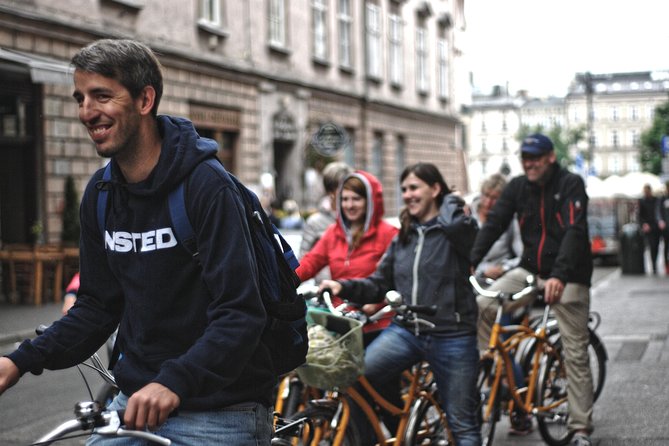
With an average group size of just 8 participants, this tour offers a personal and relaxed experience that larger tours cannot match. Led by native English-speaking guides, you’ll enjoy engaging stories and local insight that bring Krakow’s history to life.
We begin in Krakow’s Main Market Square — the largest medieval square in Europe — before heading to our nearby shop to collect comfortable Beach Cruiser bikes. From there, we explore Krakow’s most important landmarks and hidden corners, discovering traces of over 2,000 years of history along the way.
This tour is designed as the perfect introduction to the city, helping you better plan the rest of your stay. No cycling experience is nec...
Points forts
4 heures
Proposé en Anglais & Néerlandais
Annulation gratuite
Billet mobile
4 heures
Proposé en Anglais & Néerlandais
Annulation gratuite
Billet mobile
Ce qui est inclus
Helmet available but not mandatory for those under 16 years
Local native-English speaking guide
Beachcruiser style bikes for comfort not sport
Poncho de pluie, si nécessaire
We stop at a local bar where hot meals and drinks are available. There are other options in the vicinity such as a bakery, store, and ice-cream parlour
Points de rendez-vous
Départ
Sławkowska 6A
In the courtyard of our office
Retour
Visite à vélo des points forts de Cracovie - Petit groupe
(720) Avis
Krakow
À propos
With an average group size of just 8 participants, this tour offers a personal and relaxed experience that larger tours cannot match. Led by native English-speaking guides, you’ll enjoy engaging stories and local insight that bring Krakow’s history to life.
We begin in Krakow’s Main Market Square — the largest medieval square in Europe — before heading to our nearby shop to collect comfortable Beach Cruiser bikes. From there, we explore Krakow’s most important landmarks and hidden corners, discovering traces of over 2,000 years of history along the way.
This tour is designed as the perfect introduction to the city, helping you better plan the rest of your stay. No cycling experience is nec...
Points forts
4 heures
Proposé en Anglais & Néerlandais
Annulation gratuite
Billet mobile
4 heures
Proposé en Anglais & Néerlandais
Annulation gratuite
Billet mobile
Ce qui est inclus
Helmet available but not mandatory for those under 16 years
Local native-English speaking guide
Beachcruiser style bikes for comfort not sport
Poncho de pluie, si nécessaire
We stop at a local bar where hot meals and drinks are available. There are other options in the vicinity such as a bakery, store, and ice-cream parlour
Our tour begins in Kraków's magnificent Main Market Square, the vibrant centerpiece of the UNESCO-listed Old Town. For centuries, this vast medieval square has served as the city's commercial, political, and cultural hub. As we explore on foot, you'll hear stories of kings, merchants, and local traditions while taking in architectural treasures including St. Mary's Basilica, the Cloth Hall, and the historic Town Hall Tower. It's the perfect introduction to Kraków's remarkable past and present.
10 minutes
2
Croisière à vélo et en Segway à Cracovie
Each guest is provided with a bicycle suited to their individual needs, and our team will make any necessary adjustments to ensure the perfect fit. Once everyone is ready, your guide will provide a short orientation before we begin exploring Kraków by bike.
10 minutes
3
Parc Planty
Surrounding Kraków's UNESCO-listed Old Town, Planty Park is a picturesque 4-kilometer ring of gardens and promenades created on the site of the former medieval city walls. This leafy oasis features centuries-old trees, elegant flowerbeds, statues, and charming walking paths, making it one of the city's most beloved green spaces. As we travel alongside the park, you'll gain insight into Kraków's transformation from a fortified medieval city to the vibrant cultural capital it is today.
15 minutes
4
Barbican, Musée de Cracovie
Step back in time as we visit Kraków's best-preserved medieval fortifications. Dominated by the striking Barbican Fortress and the historic St. Florian's Gate, this area once formed the main entrance to the walled city. Surrounded by remnants of the original defensive walls, it provides a fascinating introduction to Kraków's medieval heritage and the stories of the kings, merchants, and citizens who passed through these gates for centuries.
7 minutes
5
Jadwiga and Jagiello Monument
At the monument to Queen Jadwiga and King Władysław Jagiełło, you'll discover the story of one of the most important royal unions in European history. Their marriage united the Kingdom of Poland and the Grand Duchy of Lithuania, laying the foundations for a powerful state that would become one of the largest and most influential countries in Europe. This stop offers a fascinating insight into the origins of the Polish-Lithuanian Commonwealth and its lasting impact on the region's history.
10 minutes
6
Église collégiale universitaire Sainte-Anne de Cracovie
As we pass St. Anne’s Church, we enter one of the oldest academic districts of Kraków, where student life and city life have been intertwined for centuries. In the late 15th century, this area was at the centre of growing tensions involving students from the nearby university and parts of the city’s population, including its Jewish residents.
The situation escalated during the reign of King Jan I Olbracht, who ultimately made a decisive and far-reaching choice. In 1495, he ordered the relocation of Kraków’s Jewish community to the district of Kazimierz. This moment marked a significant turning point in the city’s history, reshaping its social landscape and setting the foundations for the distinct cultural quarters that would define Kraków for centuries to come.
5 minutes
7
Université Jagellonne
The Oldest Building of the second oldest University in central Europe
10 minutes
8
Musée de l'Université Jagellonne Collegium Maius
We now step into the courtyard of the Collegium Maius, the oldest building of Kraków’s Jagiellonian University and one of the most atmospheric corners of the Old Town. Surrounded by Gothic arcades and centuries of academic tradition, this is where scholars once studied, taught, and shaped ideas that spread far beyond Poland.
As the clock begins its performance, figures emerge and move in sequence, bringing to life scenes from the university’s long history. It’s a quiet but captivating moment that reflects the rhythm of academic life here for over 600 years, and offers a glimpse into the intellectual heart of medieval Kraków.
10 minutes
9
Bishop's Palace
We continue to the Bishop’s Palace, one of the most important residences in Kraków’s ecclesiastical history and a place closely associated with Pope John Paul II. As Archbishop of Kraków, Karol Wojtyła lived here for many years, often greeting crowds from the famous “Papal Window” above the courtyard. During the communist era, this became a powerful symbol of hope and resistance, as well as a focal point for visits from young people who would later follow him to the Vatican. Today, the palace remains a living reminder of his life, legacy, and deep connection to the city.
7 minutes
10
Château royal de Wawel
From the foot of Wawel Hill, we take in one of the most iconic views in all of Poland. Rising above the Vistula River, Wawel Castle was once the original seat of Polish kings and the political heart of the kingdom for centuries. This was where monarchs were crowned, royal decisions were made, and the story of the Polish state truly began.
Today, the castle complex is home to a series of fascinating exhibitions that bring this history to life. Inside the Royal State Rooms, you’ll find lavishly restored interiors that once hosted royal ceremonies and dignitaries. The Royal Private Apartments reveal the more personal side of court life, while the Crown Treasury and Armoury display priceless regalia, weapons, and artefacts from Poland’s royal past. Together, they offer a remarkable journey through the power, culture, and legacy of the Polish monarchy.
5 minutes
11
Monument du Dragon du Wawel
Beneath Wawel Hill lies the legendary Dragon’s Den, a limestone cave wrapped in myth and the earliest layers of Kraków’s history. Long before the city as we know it existed, this area was inhabited by early Celtic groups and later by the Vistulan tribe, one of the Slavic peoples who shaped the foundations of the region.
It is here that legend and history intertwine. According to the famous tale, a fearsome dragon once lived beneath the castle, terrorising the local population and demanding regular sacrifices. Many brave warriors tried and failed to defeat it, until a clever cobbler named Skuba devised a trick to outwit the beast. He fed the dragon a sheep stuffed with sulphur, causing it to burst after drinking water from the Vistula.
In some versions of the story, Skuba is rewarded by the king with great honour—and even the promise of Princess Wanda’s hand in marriage.
10 minutes
12
Église sur le Rocher
Our journey continues to the Church on the Rock, known locally as Skałka, one of Kraków’s most important historic and spiritual sites. Perched above the Vistula River, this church has been a place of worship and pilgrimage for centuries, most famously associated with the martyrdom of St. Stanislaus in the 11th century, one of Poland’s patron saints. Today, it remains a powerful symbol of faith and national identity, and a place where history and legend are deeply intertwined.
7 minutes
13
La place des héros du ghetto
We arrive at Heroes of the Ghetto Square, a place of deep historical significance that once lay at the heart of the Kraków Ghetto during World War II. Today, it stands as a memorial space with powerful symbolism, marked by empty chair monuments that represent the thousands of Jewish residents who were forced from their homes and later deported during the Nazi occupation.
Facing the square is the famous Eagle Pharmacy (*Apteka pod Orłem*), one of the few non-Jewish-owned businesses allowed to operate inside the ghetto. It became an extraordinary place of refuge and quiet resistance, where pharmacist Tadeusz Pankiewicz risked his life to help Jewish residents by providing medicine, food, and shelter whenever possible. His actions later earned him recognition as a Righteous Among the Nations.
This area is also connected to the early life of director Roman Polanski, who survived the Kraków Ghetto as a child.
5 minutes
14
Fragment du mur du ghetto
We now stop at a preserved fragment of the original Kraków Ghetto wall on Lwowska Street, one of the few physical remnants of the enclosed district that once separated the Jewish population from the rest of the city during the Second World War.
Erected by the Nazi authorities in 1941, the wall formed part of the sealed ghetto that confined thousands of Jewish residents in increasingly overcrowded and harsh conditions. Today, this surviving section stands as a quiet but powerful memorial, offering a tangible link to one of the most tragic chapters in Kraków’s history and reminding visitors of the human stories behind these streets.
5 minutes
15
L'usine d'émail d'Oskar Schindler
We conclude this part of our journey at Schindler’s Factory, one of the most powerful reminders of Kraków’s wartime history. Originally an enamelware factory owned by Oskar Schindler, it became a place of extraordinary human stories during the Second World War, when Schindler employed and protected more than a thousand Jewish workers, saving them from deportation to concentration camps.
Today, the former factory has been transformed into the Museum of Kraków during the Occupation, with exhibitions that recreate the atmosphere of the city under Nazi rule. Through immersive displays, personal testimonies, and historical artifacts, visitors gain a deeply moving insight into everyday life during the occupation, the tragedy of the Holocaust, and the acts of courage and resistance that emerged in the darkest of times.
8 minutes
16
New Jewish Cemetery
We continue to the New Jewish Cemetery in Kraków, one of the most important and moving Jewish heritage sites in the city. Established in the early 19th century, it became the main burial ground for Kraków’s Jewish community as the historic cemetery in Kazimierz reached capacity.
Walking among its rows of weathered matzevot (tombstones), you’ll find the graves of rabbis, scholars, artists, and ordinary families, many of whom shaped the cultural and spiritual life of Kraków for generations. The cemetery also bears the scars of history, with damage from the Second World War still visible in places, serving as a quiet reminder of the community’s suffering and resilience.
Today, it remains an active place of remembrance and reflection, offering a powerful insight into the long and complex history of Jewish life in Kraków.
5 minutes
17
Rue Broad
We now enter Szeroka Street, the historic heart of Jewish Kazimierz and one of the most important centres of Jewish life in Poland for centuries. Unlike a typical street, Szeroka was designed as a spacious marketplace and gathering place, serving as the social, religious, and commercial hub of the Jewish community from the 15th century onward.
Surrounded by historic synagogues, prayer houses, and former community buildings, this remarkable square witnessed the flourishing of Jewish culture, scholarship, and tradition that made Kraków one of the leading centres of Jewish life in Europe. Today, its unique atmosphere reflects both the richness of that heritage and the revival of Kazimierz as a vibrant cultural district. As we explore the area, we uncover stories of faith, learning, resilience, and the generations of people who helped shape the identity of this extraordinary neighbourhood.
15 minutes
18
Old Synagogue
We now arrive in the heart of Kraków’s historic Jewish quarter, at Szeroka Street, once the main square of the Kazimierz district and the traditional centre of Jewish life for centuries. Lined with historic buildings and atmospheric courtyards, this area was the social, religious, and cultural hub of the community.
Just nearby stands the Old Synagogue, the oldest surviving synagogue building in Poland, which today serves as a museum preserving the story of Jewish life in Kraków. A short walk away is the Remuh Synagogue, still an active place of worship, closely connected to the adjoining Remuh Cemetery—one of the oldest Jewish cemeteries in Europe, where the gravestones of renowned rabbinic figures, including Rabbi Moses Isserles (the Remuh), draw visitors from around the world.
Together, these sites offer a powerful glimpse into the enduring heritage, faith, and traditions of Kraków’s Jewish community, which has shaped the identity of Kazimierz for over 500 years.
40 minutes
19
Remuh Cemetery
We now visit the Old Jewish Cemetery in Kraków’s Kazimierz district, one of the oldest surviving Jewish burial sites in Europe. Established in the 16th century, it served as the main cemetery for the city’s Jewish community for centuries, becoming a place of memory, tradition, and deep spiritual significance.
As we look through the historic gate, we see a quiet world of weathered tombstones, many richly decorated with symbolic carvings that reflect the lives and legacies of those buried here. Among them rest prominent rabbis, scholars, and members of Kraków’s Jewish community, whose stories form an essential part of the city’s cultural heritage. Despite periods of destruction, especially during the Second World War, the cemetery remains a powerful testament to resilience and remembrance.
5 minutes
20
plac Nowy
Our route takes us through Plac Nowy, the lively heart of modern Kazimierz and one of Kraków’s most vibrant gathering places. Established in the 19th century, the square has long served as a local marketplace, bringing together residents, traders, and visitors from across the city.
At its centre stands the distinctive round building known as the Okrąglak, originally used as a poultry market and now famous for serving some of Kraków’s most popular street food. Today, Plac Nowy blends the district’s rich Jewish heritage with its contemporary character, surrounded by cafés, restaurants, bars, and cultural venues. It is a perfect example of Kazimierz’s remarkable transformation from a historic neighbourhood into one of the city's most dynamic and creative districts.
5 minutes
21
Place du Petit Marché
Just a short distance from the Main Market Square lies Mały Rynek, or the “Little Market Square,” a charming and often-overlooked corner of Kraków’s Old Town. Created as part of the city's medieval expansion in the 13th century, it served as a secondary marketplace where traders sold goods that could not be accommodated in the larger central square.
Surrounded by historic townhouses and quieter than its famous neighbour, Mały Rynek offers a glimpse into the everyday life of medieval Kraków beyond the grand public spaces. Over the centuries, it has hosted markets, celebrations, and community gatherings, while retaining a more intimate atmosphere. Today, it remains a hidden gem within the UNESCO-listed Old Town, providing a peaceful contrast to the bustle of the Main Market Square.
5 minutes
22
Théâtre Slowacki
Standing proudly at the edge of Kraków’s Old Town, the Juliusz Słowacki Theatre is one of the city’s most beautiful and prestigious cultural landmarks. Opened in 1893 during a period of artistic and national revival, the theatre quickly became a symbol of Polish culture and identity at a time when Poland did not exist as an independent state.
Inspired by the grand opera houses of Vienna and Paris, its richly decorated façade and elegant architecture reflect the ambition and confidence of Kraków at the end of the 19th century. Named after the renowned Polish Romantic poet Juliusz Słowacki, the theatre has hosted generations of actors, playwrights, and artists, becoming one of the country's most important stages.
Today, it remains a vibrant centre of performing arts and a lasting reminder of the role culture played in preserving Polish identity through some of the nation's most challenging periods.